Showing posts with label national midget auto racing hall of fame. Show all posts

Monday, August 17, 2020

Steve Cannon


Steve Cannon 


A post on Facebook by our friend  Stan Kalwasinski of Steve Cannon the feature winner on May 18 1979 at the Chicago area Santa Fe Speedway along with his car owner Dick Heerboth in a Volkswagen powered car brought to mind Cannon's story shared when he was inducted into the National Midget Auto Racing Hall of Fame.   

Stephen "Steve" Cannon from the racing capital of Danville Illinois scored 21 United States Auto Club (USAC) National midget series wins during his sixteen-year midget racing career. 

Most remarkable is that Steve matched the win totals of fellow Hall of Fame members Rex Easton and Jimmy Caruthers in just 219 career starts. Steve was sometimes often too busy to race - in addition to midget racing, he was also a barber, like his brothers, ran an insurance agency and was a 29-year member of the Danville Fire Department. 

Steve began racing modified stock cars during the early nineteen sixties and by 1969 was a strong competitor in ‘Class A’ supermodifieds at the Williamson County Speedway in Marion Illinois. 1970 found Steve in competition in a midget with the St. Louis Auto Racing Association (SLARA), and then in 1971, Steve notched his first and second career USAC midget wins at Santa Fe Speedway and Quad Cities Speedway in a span of just two days.    

After a solid 1973 season in which he notched five USAC wins, in 1974 Steve started the season with a victory at the Fort Wayne Indiana Memorial Coliseum and the Indoor championship, then led all USAC Midget racers with a season-high six wins and a fifth place finish in the USAC National midget points standings. 
  
In 1976 Steve had another sterling season, with three USAC victories. In two of the most prestigious midget races of 1976, Steve finished as the runner-up to Gary Bettenhausen in the “Night before the 500” and he followed Bob Wente across the finish line in the “Hut Hundred” at the Terre Haute Action Track. Cannon was an adept racer indoors as he won a total of three features at Fort Wayne and in 1978 he beat a star-studded field to win a 100-lap race inside the Indiana State Fair Coliseum.

Steve Cannon was one of the most efficient midget racers ever, as he won nearly 10 percent of his starts and finished on the podium 25% of the time, an enviable record that earned him National Midget Auto Racing Hall of Fame membership. Steve sadly passed away on September 17 2015 in his hometown after a long illness. 


Friday, July 17, 2020

George Zarounian


George Zarounian 

Kevin Triplett's Racing History
photo by the author 

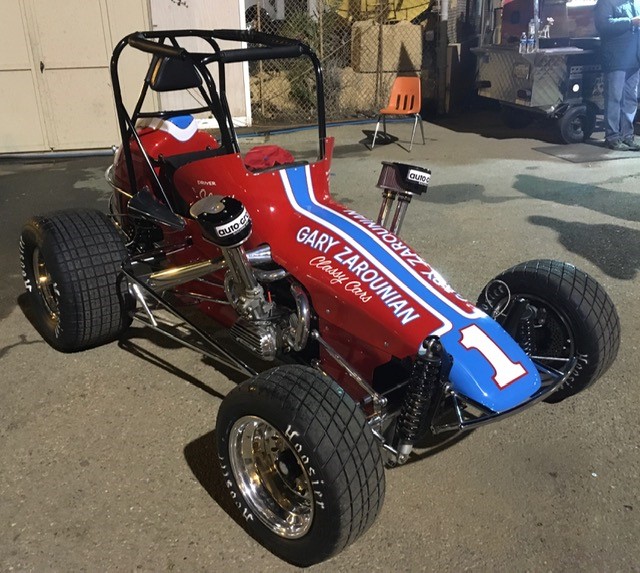
Arakel ‘George’ Zarounian was born into an Armenian farming family in the central California town of Goshen, California on December 28, 1920, the first of their four children.  George was in love with automobiles from an early age and built his first midget race car while still in high school. Following his service in the United States Army during World War Two, in 1948 Zarounian opened his first car dealership starting with just one car.

George whose trademarks were cigars, black Cadillacs, and cowboy hats opened his Cadillac/Oldsmobile dealership in Visalia in 1954, and while the automobile business remained a constant throughout his life, Zarounian was a prolific entrepreneur with many successful businesses that included tomato packing, restaurants, and real estate investments. 
 
Zarounian Motorsports, which included George’s son Gary, was dominant for two decades on the West Coast with Hall of Fame driver Ron “Sleepy” Tripp. They combined for more than eighty USAC Western States feature victories and seven season championships in ten years - 1983, 1985, 1987, 1998, 1990, 1991, and 1992. In addition the Zarounian team scored eleven feature wins in the United States Auto Club (USAC) National Midget series as well as fifteen USAC Silver Crown victories.

Zarounian cars won the Belleville Midget Nationals three times; twice with Tripp and once with Jack  Hewitt as the drivers while the team used three different engines – VW, Cosworth and Arias - and two different chassis - Beast and Edmunds. 

The “who’s who” list of drivers who drove the Zarounian #67 cars through the years includes Donnie Beechler, who won the 1995 Chili Bowl Nationals for “GZ,”, Tony Hunt,  Ed Carpenter, Kasey Kahne, Steve Knepper, Bud Kaeding, Dave Strickland Junior, Jeff Gordon and the California father and son team of Ken and Chad Nichols. 

George Zarounian died on January 3, 2014 just a few days after he celebrated his 94th birthday. The inscription on this National Midget Auto Racing Hall of Fame member’s grave marker truly sums up how he lived his life “I did it my way.”

Thursday, May 21, 2020

Wes Saegesser


Wes Saegesser 
2016 NAMRHoF inductee 


By any measure, with 117 documented wins over twelve seasons, equally divided between the pre-and post- war racing eras, in eleven different states and the province of Ontario Canada, Wesley “Wes” Saegesser had a great midget racing career. 

Wes’ accomplishments become even more remarkable when one learns that all those race wins came while driving with only one arm, since Wes was born with shortened left arm without a hand and he did not use a prosthetic device while racing. 

Born in Grand Island Nebraska in 1908, Wes began racing International Motor Contest (IMCA ‘big cars’ on the dangerous South & Midwest fair circuits in 1932 before his career was temporarily slowed in 1933 when he broke his neck in a racing accident.   

Saegesser scored his first midget win with an Elto outboard powered machine in 1937 in Kansas City Missouri and claimed both the 1937 Southwestern Championship and the Tulsa Championship.

The following year, Wes frequently raced on the Zeiter Speedways circuit and notched fifteen feature wins that included back-to-back wins in an afternoon-evening split July 4th program in Ithaca Michigan and scored three straight feature wins at the ¼-mile Yellow Jacket Speedway near Philadelphia. 

In 1939, Wes won a startling twenty-one feature races, followed by eighteen more wins in 1940. Before racing was halted due to World War Two, Saegesser claimed both the 1942 Texas/Oklahoma Midget series championship and the Houston Speed Bowl championship the latter after six consecutive wins.

When racing resumed after World War Two, during the winters of 1946-47 and 1947-48, Wes dominated the winter series of races held at the Pan-American Speedway in San Antonio Texas.  During the 1949 season Wes notched six more feature wins and accepted a new role as the American Automobile Association (AAA) Southwest zone supervisor. 

Saegesser retired from racing after the 1950 season to open his own garage in St Louis Missouri which he ran until he passed away in August 1957 of a heart attack.  Wes Saegesser the trailblazing one-armed midget champion into the National Midget Auto Racing Hall of Fame.  

Wednesday, May 6, 2020

2009 NMARHOF inductee 
Jeff Gordon's 
1990 midget race car 


This historic midget race car was on display in the MPD  Racing booth at the 2019 Performance Racing Industry (PRI) trade show. This car, owned then (and now) by Rollie Helmling was driven by a young 19 year old racer named Jeff Gordon.


Gordon dominated the 1990 United States Auto Club (USAC) midget season in this Diet Pepsi-sponsored Beast chassis with Pontiac power. His notable wins included his second consecutive win in the Night Before the 500 race at Indianapolis Raceway park,  the Hut Hundred at the Terre Haute Action Track, and the Belleville Midget Nationals in Kansas, with the season capped off when Gordon won the USAC National Midget driving title and Helmling the car owner title. 


Jeff Gordon was inducted into the National Midget Auto Racing Hall of Fame in 2009 

All photos by the author.   


Monday, April 20, 2020


Boots Archer


Born in 1913 in Oakland California, in 1931 David J. Archer Junior, known as  "Boots" started to work for a Bay Area well drilling company. He worked in the well drilling, pump installing and repairing field for other for ten years until he decided to start his own business in San Francisco in May of 1941 named Pump Repair Service Company. As the business grew, his wife Helen joined the company and managed the office.

In 1955, Boots’ son, David “Dave” Archer III joined the family business. Over the years, Dave learned the business and eventually in 1980 took over ownership of the company when “Boots” retired.  The company is still family owned by Dave Archer and his sons Wayne and Steve.


‘Boots’ first entered the “racing game” as a mechanic and partner in a Ford touring stock car with his friend Lynn Deister in the mid 1930’s. Sadly, Deister died in a midget racing crash at Bayshore Stadium in South San Francisco on Labor Day 1947.

After World War Two, ‘Boots’ served as the Business Manager for the Bay Cities Racing Association (BCRA) from 1945 to 1948, when he was forced to resign due to the growing demands of his pump business. While he was the Business Manager of BCRA, “Boots” made a strong effort to unite the BCRA (Northern California) and United Racing Association (URA) of Southern California but his efforts fell short.  

Less than a year after he resigned, ‘Boots’ returned to the BCRA Business Manager’s role on an interim basis after 1945 BCRA champion Bob Barkheimer who quit his race driving career to take over as BCRA business manager, resigned to take over management of the San Jose Speedway. “Boots” managed the BCRA operation for nearly two months until Ab Allen was hired as a permanent replacement. 

‘Boots’ served throughout the 1950’s and  1960’s as the referee at BCRA racing events, including the legendary winter time Pacific Coast Indoor Auto Racing Championship midget auto racing events held indoors at the Oakland Exposition Building.  For most of those years, ‘Boots’ was assisted by Northern California auto racing legend Jerry Piper, while Mel Fernandez served as the flamboyant starter.

Boots’ racing efforts were not confined just to midget auto racing, as due to knowledge of racing rules he also served as the referee for many major west coast stock car races promoted by Bob Barkheimer, such as the 1953 National 500-lap Stock Car Race held at Oakland Speedway. 

‘Boots’ also served as the chairman of California Auto Racing Fan Club (CARF) and for many years hosted that club’s annual Indianapolis 500-mile breakfast and remote viewing party. In September 1970, ‘Boots’ served as the referee of the inaugural ‘California 500’ USAC (United States Auto Club) championship car race at Ontario Motor Speedway, working alongside stewards Richard King and J. Gordon Betz and starter Shim Malone.

Boots became a member of the BCRA Hall of Fame in 1987 and passed away at age 83 in 1996.

Monday, April 13, 2020


Hall of Fame spotlight 
Johnnny Mantz


John Robert "Johnny" Mantz was born in 1918 in Hebron Indiana but grew up in Southern California and worked on his family’s farm before he started racing motorcycles. In 1940 he switched to racing midgets with the United Midget Association as a teammate to his car owner, Gib Lilly, before he joined the military in April 1942.

With the war over,  Mantz resumed action with the United Racing Association (URA) and posted three feature wins during 1946. In 1947,  Mantz finished second in the standings on the URA ‘Blue’ circuit for Offenhauser powered machines with eleven wins and placed eleventh in the URA ‘Red’ or non-Offenhauser circuit points with nine wins. 

During early June 1947, Johnny won five races in a three-week stretch and in September he won three races over a six-day period. “Joltin’ Johnny’s” 1947 season wins came at tracks in Bakersfield, Culver City, Carpinteria, the Rose Bowl and Balboa Stadiums and the Orange Show Speedway where Mantz won four features and scored six trophy dash wins.

After 1947 Mantz raced a ‘big car’ and championship car for JC Agajanian, won two American Automobile Association (AAA) championship car races, and was crowned the 1949 AAA Pacific Coast ‘big car’ champion. 

While he retired from racing open-wheel cars in early 1950, Mantz continued to race stock cars – he ran four of the five Mexican road races and scored a best finish of second in class in 1952. On Labor Day 1950, Mantz drove a 1950 Plymouth coupe to victory in the first 500-mile ‘Strictly Stock Car” race at Darlington South Carolina and he was crowned the inaugural 1956 USAC stock car champion.

Johnny lost his left arm after a horrific winter 1962 highway accident, and he died on October 25 1972 in another highway crash near his home in Ojai California. 

Mantz was inducted into the West Coast Stock Car Hall of Fame in 2004, and since 2009, the NASCAR ‘Southern 500’ has awarded the Darlington race winner the “Johnny Mantz Trophy.” We are proud to have midget racing pioneer Johnny Mantz as a member of the National Midget Auto Racing Hall of Fame.

Monday, September 16, 2019


Bob Marshman
2018 NMARHoF inductee


George Robert “Bobby” Marshman was born on September 24, 1936 in Pottstown Pennsylvania into a racing family, as the son of George Marshman who reigned as the 1949 American Automobile Association (AAA) East Coast Midget series champion and later became the promoter of Hatfield Speedway.

At age 19 Bobby started his racing career with the United Racing Club in a sprint car and was the club’s 1955 Rookie of the Year then the following season he was eighth in URC points in the Ellis Brothers Dodge.  After he finished second in URC points in 1957 though with no wins, in 1958 Bobby began his midget racing career with the American Race Drivers Club (ARDC). 

At just 23 years of age, Bobby drove for the powerful Harry Hespell 4-car team with multi-time ARDC champions Ed “Dutch” Schaffer and Len Duncan and Wayne Doerstler and wound up third in 1958 points in that very competitive series. Bobby started his record of success at the big Trenton New Jersey one-mile track as he won a 25-mile ARDC feature on August 3, 1958.  Marshman branched out into USAC (United States Auto Club) competition in the 1959 season still with the Hespell team teamed with Duncan, Al Herman, and Don Allison. 

Bobby started his 1960 season with a win in a 35 lap three quarter midget race on the 1/10 track inside the Island Garden on January 3, then at the end of February he scored a stock car win inside the Teaneck New Jersey Armory. Marshman drove for Bruce Homeyer’s ‘Konstant Hot’ team in 1960 and won the 300-mile ARDC midget race held at Trenton on July 24, 1960.  Bobby led the final 109 laps and finished in 3 hours 8 minutes, yet he finished only 25 seconds ahead of Chuck Arnold.

At the 1961 Indianapolis ‘500,’ Marshman was the youngest driver in the field as he started last in Eph Hoover’s ‘Hoover Motor Express Special.’ With just five days of practice, he finished the race in seventh place and shared the Rookie of the Year award with Parnelli Jones.

Bobby’s career record includes eight ARDC feature wins and four USAC feature wins, and he excelled in long-distance midget races, particularly, as he won the 250-mile USAC/ARDC at Trenton on July 2, 1961.  Due to the sweltering heat Bob gave way to relief driver Jimmie Davis after 186 laps but the pair still finished at an average speed of over 93 miles per hour (MPH). 

Marshman’s midget schedule slowed down in 1962 onward as he became a regular on the USAC championship car circuit – in 1962 he was the third fastest qualifier at Indianapolis and finished fifth in championship points. On September 16, 1962 Marshman won the USAC sanctioned 100-mile midget in a record time of one hour and 1.48 seconds. 

As Bob’s fame began to spread he got more opportunities to display his skills – he won the shortened 1962 Bobby Ball Memorial race for dirt championship cars at the Arizona State Fairgrounds in Lindsay Hopkins’ Kuzma Offenhauser,  a victory in USAC Sprint Car competition 1963 at the Terre Haute Action Track for Wally Meskowski,  and in 1964 driving Don White’s Zecol-Lubaid Ford stock car, Bobby won the   Allen Crowe Memorial raceat the Illinois state fairgrounds without a pit stop.

In 1964, his tenth season of racing Bobby qualified second at the Indianapolis ‘500’ and led 33 laps, but sadly one of racing’s brightest stars passed away on December 5. 1964, just a week after a fiery crash during a tire test at the Phoenix International Raceway at just 28 years old.

Tuesday, June 4, 2019


Billy Garrett


William J. "Billy" Garrett was a second-generation midget racer who debuted alongside his father, Johnny, in United Racing Association (URA) midget competition in 1952.  Billy, born in 1933 in Illinois and a welder by trade had a rough start in midgets during the 1952 season but his driving skills improved quickly and the following year was considered one of the “leading lights of the URA” along with Don Cameron, Johnny Moorhouse and Hal Minyard.

Billy won his first feature at Culver City Speedway on April 10 1954 driving Ben Humke’s Ford V-8 60 powered midget a year after his father’s passing in a “big car” crash at Clovis California.  Garrett won his third feature race of the 1954 season on September 25 at Culver City and clinched his first URA driver’s championship.


Early in the 1955 season Billy trailed Jack Jordan in the URA point chase until the season’s third race, but after Garrett won that 30-lap main at Gardena Stadium he never relinquished his points lead and clinched his second consecutive URA title at Orange Show Speedway in mid-September.

In 1956 Billy headed back east to race with the United States Auto Club (USAC), was the youngest driver in that year’s Indianapolis ‘500’ and appeared in nine 1956 USAC championship races driving the Greenman/Casale entry. The highlight of Billy’s 1957 USAC season came in April when he won the 100-mile midget race at the Arizona State Fairgrounds mile in record time.

Billy drove second generation Oklahoma oil magnate Harry Allen "H.A" Chapman’s year-old dark blue Kurtis-Kraft 500 'G' "laydown" roadster in the Indianapolis 500-mile race.  Chapman an amateur road racer who also owned a home in Tucson Arizona, had first entered AAA championship racing in the 1950 season with NMARHoF member Bill Schindler as  his driver.


Chapman proved to have an eye for talent as through the years, other Chapman drivers included Hall of Famers Tony Bettenhausen and Johnny Thomson and Chapman's chief mechanic was the wily veteran Art Sims.  


in 1958 Though Dick Rathman was entered as the driver of the 'Chapman Special,' he jumped to the new Lee Elkins owned Watson roadster, and after multiple driver changes, Billy wound up in the seat of the 'Chapman Special' and qualified 15th for the 33-car field. On Memorial Day, as a sophomore driver Billy miraculously avoided the first lap  turn three carnage started by Rathman that clamed the life of Pat O'Connor, but the car retired on lap 80 with a broken camshaft gear. 


A week later, after a strong second place qualifying effort, while he was running in fourth place on lap 54 of the 'Rex Mays Classic' at Milwaukee's State Fair Park, the Offenhauser engine in the Chapman Special blew up and Billy's car spun hard backwards into the third turn wall.


Billy suffered severe head and chest injuries, was listed in critical condition for a month and remained unconscious over two months. When he awoke, the 25-year old driver learned that he was permanently partially paralyzed.


Even after he could no longer drive racing cars, Garrett always remained close to the sport he loved and he sold racing safety equipment. Later in life, Billy confined full-time to a wheelchair was one of the beneficiaries of the annual ‘Gilmore Roars Again’ party until his passing in 1999. We are proud that URA 2-time champion Billy Garrett is a member of the National Midget Auto Racing Hall of Fame.  

Monday, May 20, 2019


Kenny Irwin Jr.
2018 NMARHOF Inductee 


Kenny Irwin, Jr. began his racing career in quarter midgets while in the second grade, but his racing career took a detour from 1988 to 1991 as he and his father raced a family-owned Buick Somerset in SCCA Trans-Am and IMSA GT racing series. In 1991 Kenny debuted in midgets with both the All-American Midget Series (AAMS) and the United States Auto Club (USAC).

Kenny claimed the 1992 AAMS championship in a season highlighted by a pair of wins on the high banks at Winchester Speedway and single wins at Salem Speedway and Indianapolis Raceway Park while he also challenged Stevie Reeves for the USAC national midget title. 

Irwin opened his 1993 campaign with a win in the Toronto Sky Dome Grand Prix 100, as he led the final 75 laps around the 1/6-mile oval and held off John Andretti for the win.  At the end of season, Kenny again finished a close second place to the repeat USAC Midget national champion Reeves. 

In 1994, Irwin finished fourth in USAC national midget points, then in August 1995 Kenny won his first and second USAC dirt races on the same day, as he won the Silver Crown and midget races at the Springfield Illinois mile dirt track.  During the 1996 USAC national midget season, Kenny drove for Steve Lewis’ Nine Racing team and scored two wins, at Richmond Virginia and Huset’s Speedway in South Dakota, and claimed the 1996 USAC National Midget Series Championship.

For 1997 Irwin went to the NASCAR Craftsman Truck series full-time, won two races and earned Rookie of the Year honors. In 1998 he moved up to the Winston Cup series and again was named Rookie of the Year.  Kenny lost his life in July 2000 in a practice crash at New Hampshire International Speedway only one month away from his 31st birthday.

In addition to his eight career USAC National Midget Series wins Irwin’s open wheel career record also count six USAC Silver Crown Series wins and seven career USAC National Sprint Car Series wins. The National Auto Racing Hall of Fame is honored to welcome Kenny Irwin Jr. as a 2018 inductee.

Tuesday, May 7, 2019


Bryan Clauson
2018 NMARHOF Inductee


Third generation racer Bryan "BC" Clauson won a quarter midget national championship and two California state championships before the Clauson family moved to Indiana to further his racing career. At the age of sixteen, Bryan started his first United States Auto Club (USAC) race in June 2005 and finished third. In October 2005, Bryan became the youngest driver ever to capture his first USAC national midget feature victory at Columbus Motor Speedway.

Clauson moved to ARCA and NASCAR stock car racing with Chip Ganassi’s team for several seasons before he returned to USAC open-wheel competition with a vengeance racing out of his adopted hometown of Noblesville Indiana.

Bryan scored wins at all the historic midget racing events – he was the two-time champion of the Turkey Night Grand Prix as won the 2009 and 2010 events held at the ½-mile paved Irwindale Speedway, as well as the 58th running of the historic ‘Hut Hundred’ in 2010. Clauson captured the Belleville Nationals title three times in 2009, 2010 and 2015, and the USAC Eldora 4-Crown Nationals midget crown in 2014, the same year that he reigned as the champion of the Chili Bowl Nationals in Tulsa Oklahoma. 

Clauson is the sixth driver to score 100 USAC feature wins and his career record of 112 USAC wins is sixth all-time behind Rich Vogler, A.J. Foyt, Ron “Sleepy” Tripp, Mel Kenyon and Dave Darland, and his total of 38 USAC national midget victories places him seventh overall with two USAC national midget titles back-to-back in 2010 and 2011.

Bryan also won three Indiana Midget Week titles, back-to-back USAC national sprint car championships in 2012 and 2013 and was the USAC National Drivers Championship winner three consecutive years in 2010, 2011 and 2012 based on points he accumulated in all three USAC national series.

Bryan set a personal goal of competing in 200 races during the 2016 season, but he lost his life in a crash as he led the 2016 Belleville Nationals. For his racing accomplishments and legacy of organ donation, we are proud to induct Bryan Clauson into the National Midget Auto Racing Hall of Fame.

Thursday, May 2, 2019


Mario Andretti
2018 NMARHoF Inductee


In 1961, young Italian immigrant Mario Andretti began his open wheel racing career in a three-quarter midget purchased from Bobby Marshman with the American Three-Quarter Midget Racing Association, then he scored his first of four ATQMRA wins with a 100-lap race win at Teaneck New Jersey in 1962. In 1963, Mario graduated to full-size midgets in his first race at Danbury Connecticut with the American Race Drivers Club (ARDC) with such legendary drivers as Len Duncan, and Ed “Dutch” Schaefer.

On Labor Day 1963, at 23 years of age Andretti accomplished the near-impossible as he won three midgets features in one day in a single car at two different tracks. In the afternoon program at the fast 5/8-mile Flemington Speedway in New Jersey Mario scored a “clean sweep” he set fast time in qualifying, won his heat race and scored the feature win.

The Mataka Brothers team then loaded up and towed west to Pennsylvania’s 1/3-mile Hatfield Speedway for the evening’s twin feature program. In the first race, Mario again scored a “clean sweep,” then won his third feature of the day with a victory in the make-up race from an earlier rain out. In one day, Mario scored three of his five career ARDC feature wins and from that day on, Mario Andretti was bound for superstardom.

Besides a NASCAR midget win and a United States Auto Club (USAC) midget win in Berlin Michigan in 1966 Mario’s record includes Rookie of the Year honors at the 1965 Indianapolis ‘500,’ victory in the 1967 Daytona 500-mile stock car race, the 1969 Indianapolis ‘500,’ and the 1978 Formula One World Driving Championship. 

Mario’s career record also includes three Sebring 12-hour race victories, four IndyCar championships with wins in each of four decades, Driver of the Year honors in three different decades and he was named the Associated Press Driver of the Century in 1999.

As a driver who started his illustrious open-wheel career in midgets, we are proud to welcome Mario Andretti into the National Midget Auto Racing Hall of Fame.

Saturday, January 19, 2019

Tommy Astone
2018 NMARHoF Inductee 


Growing up in Fresno, California, Tommy Astone’s father was a race car owner and by the age of ten Tommy knew he wanted to be a race car driver. Astone started racing super modifieds at the age of 18 before he moved in the ranks of midget racing in 1969 with the Bay Cities Racing Association (BCRA).

During his breakout 1970 BCRA season Tommy swept a twin 50-lap program at San Jose Speedway and the 50-lap Western States midget championship race at Tahoe-Carson (T-CAR) Speedway. In August 1970 at West Capitol Raceway, while he challenged for his consecutive straight BCRA feature win, Tommy tangled with another car. His midget flipped eight times and Tommy suffered a broken collarbone and broken ribs and missed five weeks.
 
In the 1970 season’s final BCRA race at Roseville Speedway, Tommy entered with a 12-point lead and only had to finish the feature to be crowned the champion. The youngster was black-flagged during the feature by BCRA officials and Gary Arnold finished in third place and won the championship over Astone by 14 points. 

By December 1970, Tommy now 21 years old he was and able to race with the United States Auto Club (USAC).  

During the 1971 season, Tommy raced with USAC, the BCRA, and the Southern California-based USRC and URA midget clubs. In 1972, Astone made his first full-season foray with USAC, finished seventh in points and was named the rookie of the year.

Astone claimed his inaugural USAC win on June 20, 1973 at the 3/8-mile clay ‘34 Speedway’ in   Burlington Iowa. The 1973 USAC midget championship was settled on the final day of the season at a twin 50-lap program at Phoenix International Raceway, and Larry Rice emerged as the champion over Astone.

In 1974, Astone spent much of the USAC season in second place in points as he won the prestigious ‘Night Before the 500’ race at Indianapolis Raceway Park.  Tommy missed the final two races of the season due to injuries he suffered in a violent crash at Clovis Speedway but had amassed enough points to again finish second in the USAC midget championship.  

In 1976, Astone finished in third place in USAC midget points before he returned to racing on the West Coast primarily with the BCRA.  Tommy’s USAC midget career includes seven USAC national wins and five USAC Western States midget wins. Tommy Astone was inducted into the Bay Cities Racing Association Hall of Fame in 2009, and now we welcome him into the National Midget Auto Racing Hall of Fame. 

Sunday, December 23, 2018

The 2018 National Midget Auto Racing Hall of Fame induction 


The 2018 class of the National Midget Auto Racing Hall of Fame induction ceremony will be held in Tulsa Oklahoma on January 18 2019. This will be an event not to be missed as all six of this year's  inductees - Mario Andretti, Tommy Astone, Bryan Clauson, Kenny Irwin Jr., Bob Marshman and Mike Streicher - will all be represented at the ceremony.  

Reservations are filling up quickly, do not be left out, contact 

kingdoodlebug@sbcglobal.net

for reservations and ticket information. The deadline for reservations is  December 31, 2018.


Sunday, August 5, 2018


Don Meacham

2012 inductee
photo courtesy of M&M Racing Photos


Charles “Don” Meacham began his long racing career at age 22 in a hardtop on the quarter-mile paved oval Kearney Bowl in his hometown of Fresno California shortly after Don finished his service in the United States Air Force. After he finished third in the 1959 season points at Kearney Bowl, he was offered an opportunity to drive Fred Hatfield’s midget with the Bay Cities Racing Association (BCRA) in Northern California.
By 1961 Meacham was racing with the elite drivers of the United States Auto Club (USAC) in selected events such as JC Agajanian’s promotion of a 50-lap race at Orange Show Speedway in a program that featured Indianapolis 500-mile race winner AJ Foyt, Danny Jones and Johnny Moorhouse.
In 1962 Don finished in the top ten in midget points at Bakersfield Speedway behind such names as Lowell Sachs and Lloyd Nygren. Don made his first start in the prestigious Turkey Night Grand Prix in November 1962 and completed the 150-lap race around the half-mile Ascot Park Speedway in seventh place.
For 1964, Mel Kenyon invited Don to travel with him on the USAC national midget circuit and as the season progressed, Meacham began to land better quality rides. Don scored his first USAC main event win at Springfield Illinois on July 13 as he drove the Saemann Grabow Offenhauser then followed that up with his second win a month later at Peoria Speedway in Illinois. Even though he raced only a partial season, Don wound up tenth in the 1964 USAC national midget standings.  
In the winter of 1965 and 1966 Meacham participated in the 14-race BCRA Pacific Coast Indoor Auto Racing Championship series held on the 1/10-mile oval inside the Oakland Exposition Building and finished in the top five in points. During the 1966 racing season as a member of the Myron Caves midget racing team Don along with teammate Mike McGreevy battled Mel Kenyon for the USAC national midget championship.
Don led all drivers as he captured nine 1966 USAC main event midgets wins but wound up third in points behind the eventual champion McGreevy and Kenyon. Don scored wins in Muncie Speedway in Indiana, Santa Fe Speedway and Bob-Jo Speedway Illinois as well as back to back wins on successive nights at Fairbury American Legion Park in Illinois. Meacham also won at the Allentown Pennsylvania fairgrounds and scored his ninth win of the 1966 season at his home track the Kearney Bowl
Don finished second in the 1966-67 BCRA Pacific Coast Indoor championship behind Billy Vukovich with 481 points to Billy’s 539 points. In May 1967, Don made the challenging jump from midgets to a rear engine car at Indianapolis teamed with a rookie car owner, Jim Hayhoe in an effort with a three-year Vollstedt chassis powered by supercharged Offenhauser engine.
The Cleaver-Brooks sponsored team fought hard and steadily improved but just couldn’t find the speed needed to make the starting field.  Offsetting his Indianapolis disappointment, Don finished fifth in the 1967 USAC National midget championship with the Myron Caves Buick Offenhauser powered midget and scored one feature win at Flat Rock Speedway in Michigan.  
In 1968 Don was invited to race “down under” in New Zealand and Australia and achieved much success with 14 wins in seventeen starts and Meacham became a great fan favorite and he returned to visit vintage events in Australia several times. Don cut back on his USAC schedule in 1968 and scored his final USAC feature victory on July 21, 1968 at Kokomo Speedway.
Later in his career, after he had retired from full-time driving and entered the orthopedic device industry, Don drove the Mason Cook Sesco-powered midget in BCRA competition against the rising tide of Volkswagen powered midgets, then he later decide that he would rather switch than fight and drove Len Gozel’s Volkswagen powered machine.  

Don Meacham in action in the Myron Caves midget in Australia
photo from the author's collection


Don’s career total of thirteen USAC national midgets wins places him in a tie with Steve Knepper, Ryan Newman and Stevie Reeves. The most remarkable aspect of his win total is that oftentimes Don raced the Caves Don Edmunds built midget without the help of a crewman.  Through his long career, Don drove for some truly legendary car owners that included his most frequent ride, the Myron Caves Offenhauser, as well as Jack London, Harry Stryker and Bob Rosen.
In addition to his membership in the National Midget Auto Racing Hall of Fame, Don Meacham is also a member of the Central California Racing Hall of Fame and was recently inducted into the Bay Cities Racing Association Hall of Fame.

Friday, July 6, 2018


Dick Atkins
2017 NMARHoF  


Richard F. "Dick" Atkins was born into a large family with eight brothers and sisters in 1936 in Oakland California, and graduated from Castlemont High School in 1954 after standout career in varsity athletes particularly in football.  Dick who worked as a building contractor in Hayward California began racing in 1960 as a hobby, and by 1963 he was a force in Bay Cities Racing Association (BCRA) competition driving Sim Clark’s Chevy II powered midget with a signature win in a 50-lap feature at Capitol Speedway on May 30 and he set a track record in June at Stockton 99 Speedway.

1964 was Atkins’ breakout season in 2017 Sim Clark’s Chevy II that included a July 4 weekend sweep of the BCRA races at Chico on the dirt at Silver Dollar Speedway and the tight paved oval at Lakeport California. During July 1964 Dick Atkins captured three consecutive wins and he was crowned the 1964 BCRA outdoor champion following in his third place finish in the October 17 1964 25-lap feature at Vallejo Speedway.

For the 1965 season, Atkins joined the multi-car team of John Pestana and Bob Lang that fielded a pair of Offenhauser-powered midgets for BCRA competition as well the former Fike Plumbing sprint car in Northern Auto Racing Club (NARC) races. Atkins won races in both divisions, notably 100-lap features at Santa Maria on Memorial Day and in July at Vallejo Speedway and claimed his second consecutive BCRA driving title.

On Thanksgiving night 1965 on Ascot Park Speedway, Atkins qualified the Pestana #3X in fifth place then watched as AJ Foyt and Parnelli Jones dueled for the early lead until Jones flipped on lap 70. Foyt continued to lead with pressure from Atkins until Foyt pitted on lap 118 and Atkins led the remaining 32 laps to claim the 25th annual Turkey Night Grand Prix victory and nationwide notoriety.

1966 was Atkins’ breakout year which began as he claimed the BCRA Pacific Coast Indoor Auto Racing Champion’s crown as joined JC Agajanian’s REV 500 racing team on the USAC (United States Auto Club) championship circuit at Indianapolis. In his first attempt to qualify for the ‘500,’ Dick passed his rookie test and qualified for the field at 158.158 miles per hour, only to be bumped out of the field the following day  by Larry Dickson and wound up the first alternate.

Days after the ‘500,’ a mechanic’s torch set off an explosion that damaged the Shrike that Atkins had driven at Indianapolis, and for the rest of the USAC season, Dick became the driver of the famed Agajanian #98 entry. Dick also found time to race sprint cars and set quick time and won the final USAC sprint car race held at the Allentown Pennsylvania fairgrounds in August. Dick finished sixth in his first appearance at the high-banked Winchester Speedway in a sprint car after he started 14th and trailed Al Smith, Bobby Unser, Mario Andretti, Roger McCluskey and Arnie Knepper to the finish line.  

Midway during the USAC championship car season, Dick began to pile up steady top ten and top five finish, and in the penultimate race of 1966 at the State Fairgrounds dirt mile in Sacramento, he qualified second. Atkins tracked leader Mario Andretti all race long then swept past to claim victory when Andretti car suffered rear end failure with six laps to go. In one year, Atkins had claimed wins in the three elite USAC classes- champ car, sprint car and midgets.

On the cusp of stardom, with a full-time ride with JC Agajanian set for 1967, Dick Atkins just thirty years old was struck down three weeks after his Golden State victory following a USAC sprint car crash at Ascot Park that also claimed the life of Don Branson. On the fifth lap of the 30-lap feature Branson in what was scheduled to be his final race became incapacitated and his car crashed hard into the outside wall.

Branson’s flipping car landed on top of Dick’s Wally Meskoswitz owned sprint car which exploded into flames. Though rescuers pulled him from the car Atkins had suffered severe burns and a basal skull fracture and he passed away in the Gardena Memorial Hospital at noon the next day. Dick just thirty years old and on the cusp of superstardom was struck down just three weeks after his ‘Golden State 100’ victory.  The tragic Branson/Atkins double fatality led USAC to mandate the use of fuel cells in both sprint cars and midgets.  

Taken from us too soon, we were honored to welcome Dick Atkins truly a phenomenal driver into the National Midget Auto Racing Hall of Fame as a member of the class of 2017 at ceremonies in Tulsa Oklahoma on January 12 2018.


Tuesday, June 12, 2018


The mission of the
National Midget Auto Racing Hall of Fame
The mission of the National Midget Auto Racing Hall of Fame (NMARHoF) is to preserve, honor and promote the heritage of the sport of midget auto racing and perpetually recognize and remember individuals who have contributed to the sport. 
Another part of our mission to maintain a permanent exhibit to provide a national presence for race fans and participants everywhere to visit and enjoy, saluting those individuals who have been enshrined as Hall of Fame inductees.
Formed in 1984 by official Ed Watson and race organizer John Stiles, the National Midget Auto Racing Hall of Fame annually announces its inductees, who are then formally honored ceremoniously.

To present an individual involved in the sport of Midget Auto racing for consideration by the induction committee for membership in the NMARHoF by contacting the organization’s National office, which in 2018 is accessed at kingdoodlebug@sbcglobal.net which will provide a nomination package.