Showing posts with label AAA. Show all posts

Friday, July 17, 2020

George Zarounian


George Zarounian 

Kevin Triplett's Racing History
photo by the author 

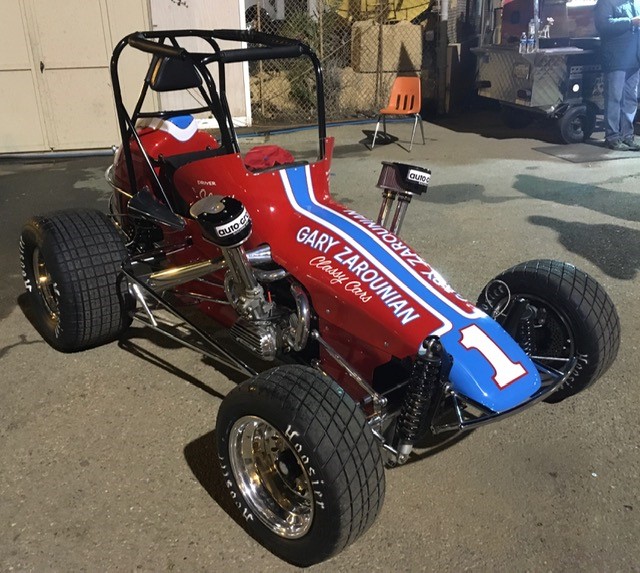
Arakel ‘George’ Zarounian was born into an Armenian farming family in the central California town of Goshen, California on December 28, 1920, the first of their four children.  George was in love with automobiles from an early age and built his first midget race car while still in high school. Following his service in the United States Army during World War Two, in 1948 Zarounian opened his first car dealership starting with just one car.

George whose trademarks were cigars, black Cadillacs, and cowboy hats opened his Cadillac/Oldsmobile dealership in Visalia in 1954, and while the automobile business remained a constant throughout his life, Zarounian was a prolific entrepreneur with many successful businesses that included tomato packing, restaurants, and real estate investments. 
 
Zarounian Motorsports, which included George’s son Gary, was dominant for two decades on the West Coast with Hall of Fame driver Ron “Sleepy” Tripp. They combined for more than eighty USAC Western States feature victories and seven season championships in ten years - 1983, 1985, 1987, 1998, 1990, 1991, and 1992. In addition the Zarounian team scored eleven feature wins in the United States Auto Club (USAC) National Midget series as well as fifteen USAC Silver Crown victories.

Zarounian cars won the Belleville Midget Nationals three times; twice with Tripp and once with Jack  Hewitt as the drivers while the team used three different engines – VW, Cosworth and Arias - and two different chassis - Beast and Edmunds. 

The “who’s who” list of drivers who drove the Zarounian #67 cars through the years includes Donnie Beechler, who won the 1995 Chili Bowl Nationals for “GZ,”, Tony Hunt,  Ed Carpenter, Kasey Kahne, Steve Knepper, Bud Kaeding, Dave Strickland Junior, Jeff Gordon and the California father and son team of Ken and Chad Nichols. 

George Zarounian died on January 3, 2014 just a few days after he celebrated his 94th birthday. The inscription on this National Midget Auto Racing Hall of Fame member’s grave marker truly sums up how he lived his life “I did it my way.”

Wednesday, June 3, 2020

The Justice Brothers


The Justice Brothers


The Justice Brothers were born in the tiny eastern Kansas town of Paola, into a family of six children. Lawrence Milton, known as “Zeke,” was born on March 12 1920 and youngest brother, Edward Ray, arrived fifteen months later on June 12 1921. Growing up, the boys and their older brother Gus, born in 1916, were obsessed with automobiles and speed. First the brothers stripped down an old Whippet before they built their own midget racer. The brothers terrorized the local residents and probably themselves with their high speed exploits in their home-built machines.

It seemed inevitable that the Justice Brothers would have to head to California to pursue their speed dreams. First Ed drove west on Route 66 in his Ford sedan and soon found work in the flight test department of Douglas Aircraft in Santa Monica. Before long, Ed sent word home to Kansas that he had found Zeke a job working in millionaire playboy Joel Thorne’s Burbank race car shop.  Unfortunately, Gus had suffered crippling injuries in a 1936 automobile accident and remained in Paola.

When World War Two came, Ed enlisted as an aircraft mechanic with the Eighth Army Air Force stationed in England, while Zeke worked during the war at Thorne Engineering building precision aircraft parts. The foreman of the Thorne Engineering shop was none other than Frank Kurtis, who later hired Zeke as his first employee when he struck out on his own to build race cars. 

Ed later also joined Kurtis-Kraft Inc. and the brothers helped construct many of the nearly 500 midget race cars K-K built during the post-war midget racing boom.  Some of which were sold as kits, and Frank Kurtis was too busy to take on repair jobs, so the enterprising pair opened Justice Brothers Race Car Repair and Fabrication in Glendale California to assemble Kurtis-Kraft midget kits and repair damaged Kurtis-Kraft race cars in their off hours.  

Once while Frank Kurtis was out of town on business, Ed convinced Zeke to help him incorporate standard aircraft fasteners for the first time on a midget race car being built by Kurtis for NMARHOF member “Bullet” Joe Garson. The pair attached the body panels using Dzus spring-loaded quarter -turn fasteners, and while Frank Kurtis was reportedly unhappy at first, the Justices sold him on their innovation which became the standard in race car fabrication.  

The brothers somehow found the time to build their own midget race car, and after just one outing at the famed Gilmore Stadium, sold the car for a $2,500 profit, which they used to invest in a Florida-based oil business.  Justice Brothers Inc. went on to sponsor the Kurtis-built 1950 Indianapolis 500 winner driven by Johnnie Parsons, Red Byron, the first NASCAR champion in 1949, and were the first sponsors of drag racing legend “Big Daddy” Don Garlits. 

Although we lost Gus in 1983, Zeke in 2001 and Ed in 2008, the Justice Brothers Inc. automotive chemicals company continues to grow under the leadership of Ed’s son, Ed Justice Junior, who is also a noted motorsports photographer, historian, broadcaster and publisher.


Thursday, May 21, 2020

Wes Saegesser


Wes Saegesser 
2016 NAMRHoF inductee 


By any measure, with 117 documented wins over twelve seasons, equally divided between the pre-and post- war racing eras, in eleven different states and the province of Ontario Canada, Wesley “Wes” Saegesser had a great midget racing career. 

Wes’ accomplishments become even more remarkable when one learns that all those race wins came while driving with only one arm, since Wes was born with shortened left arm without a hand and he did not use a prosthetic device while racing. 

Born in Grand Island Nebraska in 1908, Wes began racing International Motor Contest (IMCA ‘big cars’ on the dangerous South & Midwest fair circuits in 1932 before his career was temporarily slowed in 1933 when he broke his neck in a racing accident.   

Saegesser scored his first midget win with an Elto outboard powered machine in 1937 in Kansas City Missouri and claimed both the 1937 Southwestern Championship and the Tulsa Championship.

The following year, Wes frequently raced on the Zeiter Speedways circuit and notched fifteen feature wins that included back-to-back wins in an afternoon-evening split July 4th program in Ithaca Michigan and scored three straight feature wins at the ¼-mile Yellow Jacket Speedway near Philadelphia. 

In 1939, Wes won a startling twenty-one feature races, followed by eighteen more wins in 1940. Before racing was halted due to World War Two, Saegesser claimed both the 1942 Texas/Oklahoma Midget series championship and the Houston Speed Bowl championship the latter after six consecutive wins.

When racing resumed after World War Two, during the winters of 1946-47 and 1947-48, Wes dominated the winter series of races held at the Pan-American Speedway in San Antonio Texas.  During the 1949 season Wes notched six more feature wins and accepted a new role as the American Automobile Association (AAA) Southwest zone supervisor. 

Saegesser retired from racing after the 1950 season to open his own garage in St Louis Missouri which he ran until he passed away in August 1957 of a heart attack.  Wes Saegesser the trailblazing one-armed midget champion into the National Midget Auto Racing Hall of Fame.