Showing posts with label USAC. Show all posts

Friday, July 17, 2020

George Zarounian


George Zarounian 

Kevin Triplett's Racing History
photo by the author 

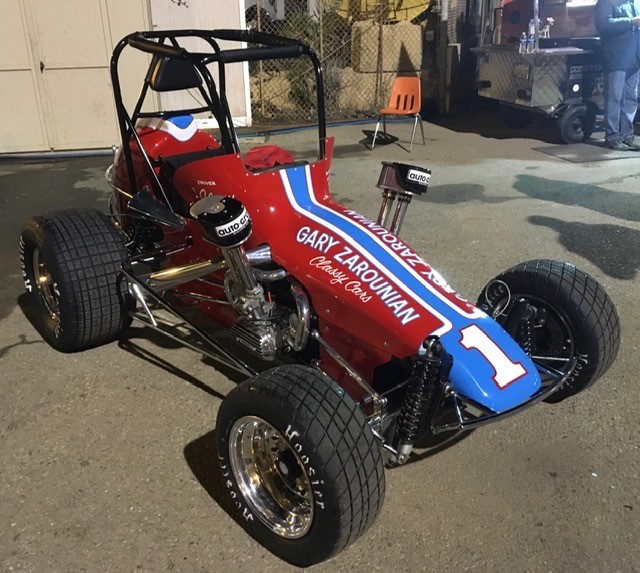
Arakel ‘George’ Zarounian was born into an Armenian farming family in the central California town of Goshen, California on December 28, 1920, the first of their four children.  George was in love with automobiles from an early age and built his first midget race car while still in high school. Following his service in the United States Army during World War Two, in 1948 Zarounian opened his first car dealership starting with just one car.

George whose trademarks were cigars, black Cadillacs, and cowboy hats opened his Cadillac/Oldsmobile dealership in Visalia in 1954, and while the automobile business remained a constant throughout his life, Zarounian was a prolific entrepreneur with many successful businesses that included tomato packing, restaurants, and real estate investments. 
 
Zarounian Motorsports, which included George’s son Gary, was dominant for two decades on the West Coast with Hall of Fame driver Ron “Sleepy” Tripp. They combined for more than eighty USAC Western States feature victories and seven season championships in ten years - 1983, 1985, 1987, 1998, 1990, 1991, and 1992. In addition the Zarounian team scored eleven feature wins in the United States Auto Club (USAC) National Midget series as well as fifteen USAC Silver Crown victories.

Zarounian cars won the Belleville Midget Nationals three times; twice with Tripp and once with Jack  Hewitt as the drivers while the team used three different engines – VW, Cosworth and Arias - and two different chassis - Beast and Edmunds. 

The “who’s who” list of drivers who drove the Zarounian #67 cars through the years includes Donnie Beechler, who won the 1995 Chili Bowl Nationals for “GZ,”, Tony Hunt,  Ed Carpenter, Kasey Kahne, Steve Knepper, Bud Kaeding, Dave Strickland Junior, Jeff Gordon and the California father and son team of Ken and Chad Nichols. 

George Zarounian died on January 3, 2014 just a few days after he celebrated his 94th birthday. The inscription on this National Midget Auto Racing Hall of Fame member’s grave marker truly sums up how he lived his life “I did it my way.”

Wednesday, June 3, 2020

The Justice Brothers


The Justice Brothers


The Justice Brothers were born in the tiny eastern Kansas town of Paola, into a family of six children. Lawrence Milton, known as “Zeke,” was born on March 12 1920 and youngest brother, Edward Ray, arrived fifteen months later on June 12 1921. Growing up, the boys and their older brother Gus, born in 1916, were obsessed with automobiles and speed. First the brothers stripped down an old Whippet before they built their own midget racer. The brothers terrorized the local residents and probably themselves with their high speed exploits in their home-built machines.

It seemed inevitable that the Justice Brothers would have to head to California to pursue their speed dreams. First Ed drove west on Route 66 in his Ford sedan and soon found work in the flight test department of Douglas Aircraft in Santa Monica. Before long, Ed sent word home to Kansas that he had found Zeke a job working in millionaire playboy Joel Thorne’s Burbank race car shop.  Unfortunately, Gus had suffered crippling injuries in a 1936 automobile accident and remained in Paola.

When World War Two came, Ed enlisted as an aircraft mechanic with the Eighth Army Air Force stationed in England, while Zeke worked during the war at Thorne Engineering building precision aircraft parts. The foreman of the Thorne Engineering shop was none other than Frank Kurtis, who later hired Zeke as his first employee when he struck out on his own to build race cars. 

Ed later also joined Kurtis-Kraft Inc. and the brothers helped construct many of the nearly 500 midget race cars K-K built during the post-war midget racing boom.  Some of which were sold as kits, and Frank Kurtis was too busy to take on repair jobs, so the enterprising pair opened Justice Brothers Race Car Repair and Fabrication in Glendale California to assemble Kurtis-Kraft midget kits and repair damaged Kurtis-Kraft race cars in their off hours.  

Once while Frank Kurtis was out of town on business, Ed convinced Zeke to help him incorporate standard aircraft fasteners for the first time on a midget race car being built by Kurtis for NMARHOF member “Bullet” Joe Garson. The pair attached the body panels using Dzus spring-loaded quarter -turn fasteners, and while Frank Kurtis was reportedly unhappy at first, the Justices sold him on their innovation which became the standard in race car fabrication.  

The brothers somehow found the time to build their own midget race car, and after just one outing at the famed Gilmore Stadium, sold the car for a $2,500 profit, which they used to invest in a Florida-based oil business.  Justice Brothers Inc. went on to sponsor the Kurtis-built 1950 Indianapolis 500 winner driven by Johnnie Parsons, Red Byron, the first NASCAR champion in 1949, and were the first sponsors of drag racing legend “Big Daddy” Don Garlits. 

Although we lost Gus in 1983, Zeke in 2001 and Ed in 2008, the Justice Brothers Inc. automotive chemicals company continues to grow under the leadership of Ed’s son, Ed Justice Junior, who is also a noted motorsports photographer, historian, broadcaster and publisher.


Thursday, May 14, 2020


George Bignotti 


A smiling George Bignotti in 1962 
Photo courtesy of the
IUPUI University Library Center for Digital Scholarship
 Indianapolis Motor Speedway Collection


Today we pay tribute to National Midget Auto Racing Hall of Fame inductee George Bignotti, another example of a great racer who started their storied career in the sport of auto racing in midget racing.  

George born in San Mateo California in 1916 was the youngest of three brothers all of whom were auto racing mechanics.  In 1946, in partnership with his brother Al, George fielded a car powered by a Ford V8-60 engine in the Bay Cities Racing Association (BCRA) for Ed Normi.

The following season, the brothers bought a second midget and added 1946 BCRA champion Fred Agabashian to their team. Agabashian had a ride in the 1947 Indianapolis 500-mile race and thus missed many races, and was listed in 22nd place in the 1947 BCRA points when he returned in June.

Through a series of consistent finishes Agabashian with George and Al turning the wrenches on the #108 midget won the 1947 BCRA drivers’ championship by 92 points. When Agabashian returned to the Bay Area after the 1948 Indianapolis 500-mile race, George Bignotti had the new Kurtis-Kraft Ford V-8 60 powered “Burgermeister Special” #154 ready for Fred.

Late in the season, Agabashian’s leading competitor, Jerry Piper broke his arm in a crash and at the end of the season the team of Bignotti and Agabashian were champions - Agabashian with his third consecutive title and Bignotti his second.

For 1949, Piper and Agabashian started the BCRA season as teammates for George Bignotti. Agabashian set quick time on three occasions during the 8-race series and eventually lowered the track record to an amazing 8.22 seconds. Fred won the penultimate feature race, but Hayward’s Bob Sweikert won the inaugural BCRA indoor championship. 
During the 1949 season George became a top driver in the BCRA’s hardtop division, and in 1951 he won the BCRA midget title for a third time with Johnny Boyd.   

For the 1954 Indianapolis ‘500’ Fred Agabashian was set to drive the ‘Merz Engineering Special’ a brand new Kurtis Kraft 500C roadster with 270-cubic inches of Offenhauser power tilted 36 degrees. The car arrived late, and Fred called to ask his friend and former car owner Bignotti to come to Indianapolis and help out the short-handed Merz crew.

That visit marked the beginning of Bignotti’s magical 29-year career at the Indianapolis Motor Speedway.  

In 1956 George teamed with Bob Bowes of the Bowes Seal Fast Company to field an entry for Johnny Boyd and in 1957 Agabashian teamed with Johnny Boyd in a pair of new Kurtis-Kraft 500G models. At the end of the 1958 season, George won his USAC first USAC championship race at Sacramento with driver Jud Larson.

In 1960, Bignotti teamed with a young Texan named A J Foyt and together they won four USAC races and the USAC championship, the first of their four USAC championships. In 1961 George the won the first of a pair of Indianapolis 500-mile race wins with Foyt.

Before he retired at the end of the 1983 racing season, Bignotti won seven USAC national championships and won the Indianapolis 500-mile race seven times. Bignotti passed away at age 97 in 2013. The National Midget Auto Racing Hall of Fame is proud to count George Bignotti as one our inductees.    

IUPUI University Library Center for Digital Scholarship Indianapolis Motor Speedway Collection

Wednesday, May 6, 2020

2009 NMARHOF inductee 
Jeff Gordon's 
1990 midget race car 


This historic midget race car was on display in the MPD  Racing booth at the 2019 Performance Racing Industry (PRI) trade show. This car, owned then (and now) by Rollie Helmling was driven by a young 19 year old racer named Jeff Gordon.


Gordon dominated the 1990 United States Auto Club (USAC) midget season in this Diet Pepsi-sponsored Beast chassis with Pontiac power. His notable wins included his second consecutive win in the Night Before the 500 race at Indianapolis Raceway park,  the Hut Hundred at the Terre Haute Action Track, and the Belleville Midget Nationals in Kansas, with the season capped off when Gordon won the USAC National Midget driving title and Helmling the car owner title. 


Jeff Gordon was inducted into the National Midget Auto Racing Hall of Fame in 2009 

All photos by the author.   


Monday, September 16, 2019


Bob Marshman
2018 NMARHoF inductee


George Robert “Bobby” Marshman was born on September 24, 1936 in Pottstown Pennsylvania into a racing family, as the son of George Marshman who reigned as the 1949 American Automobile Association (AAA) East Coast Midget series champion and later became the promoter of Hatfield Speedway.

At age 19 Bobby started his racing career with the United Racing Club in a sprint car and was the club’s 1955 Rookie of the Year then the following season he was eighth in URC points in the Ellis Brothers Dodge.  After he finished second in URC points in 1957 though with no wins, in 1958 Bobby began his midget racing career with the American Race Drivers Club (ARDC). 

At just 23 years of age, Bobby drove for the powerful Harry Hespell 4-car team with multi-time ARDC champions Ed “Dutch” Schaffer and Len Duncan and Wayne Doerstler and wound up third in 1958 points in that very competitive series. Bobby started his record of success at the big Trenton New Jersey one-mile track as he won a 25-mile ARDC feature on August 3, 1958.  Marshman branched out into USAC (United States Auto Club) competition in the 1959 season still with the Hespell team teamed with Duncan, Al Herman, and Don Allison. 

Bobby started his 1960 season with a win in a 35 lap three quarter midget race on the 1/10 track inside the Island Garden on January 3, then at the end of February he scored a stock car win inside the Teaneck New Jersey Armory. Marshman drove for Bruce Homeyer’s ‘Konstant Hot’ team in 1960 and won the 300-mile ARDC midget race held at Trenton on July 24, 1960.  Bobby led the final 109 laps and finished in 3 hours 8 minutes, yet he finished only 25 seconds ahead of Chuck Arnold.

At the 1961 Indianapolis ‘500,’ Marshman was the youngest driver in the field as he started last in Eph Hoover’s ‘Hoover Motor Express Special.’ With just five days of practice, he finished the race in seventh place and shared the Rookie of the Year award with Parnelli Jones.

Bobby’s career record includes eight ARDC feature wins and four USAC feature wins, and he excelled in long-distance midget races, particularly, as he won the 250-mile USAC/ARDC at Trenton on July 2, 1961.  Due to the sweltering heat Bob gave way to relief driver Jimmie Davis after 186 laps but the pair still finished at an average speed of over 93 miles per hour (MPH). 

Marshman’s midget schedule slowed down in 1962 onward as he became a regular on the USAC championship car circuit – in 1962 he was the third fastest qualifier at Indianapolis and finished fifth in championship points. On September 16, 1962 Marshman won the USAC sanctioned 100-mile midget in a record time of one hour and 1.48 seconds. 

As Bob’s fame began to spread he got more opportunities to display his skills – he won the shortened 1962 Bobby Ball Memorial race for dirt championship cars at the Arizona State Fairgrounds in Lindsay Hopkins’ Kuzma Offenhauser,  a victory in USAC Sprint Car competition 1963 at the Terre Haute Action Track for Wally Meskowski,  and in 1964 driving Don White’s Zecol-Lubaid Ford stock car, Bobby won the   Allen Crowe Memorial raceat the Illinois state fairgrounds without a pit stop.

In 1964, his tenth season of racing Bobby qualified second at the Indianapolis ‘500’ and led 33 laps, but sadly one of racing’s brightest stars passed away on December 5. 1964, just a week after a fiery crash during a tire test at the Phoenix International Raceway at just 28 years old.

Tuesday, June 25, 2019


Mike Streicher
2018 NMARHoF inductee
passed away November 6 2019 


We are sad to report that 2018 NMARHoF inductee Mike Streicher passed away from a heart attack on November 6 2019.


Second generation midget racer Michael “Mike” Streicher experienced success in multiple aspects of our sport. The son of three-time United States Auto Club (USAC) car owner champion Jim Streicher, the Findlay, Ohio native who attended his first midget race at the age of three, grew up to claim USAC midget championships as a driver, car owner, mechanic and a car builder. 

In 1983, Mike captured his first series title with USAC as a car owner and mechanic for driver champion Rich Vogler then in 1988 at Kokomo Speedway in Indiana, he won his first USAC midget feature as a driver. In 1990 Streicher won the Hoosier Dome Invitational, the during the 1990 USAC season, Streicher battled defending champion Russ Gamester and Jeff Gordon and wound up third in the USAC national midget championship while his father claimed the car owners title.  

1991 was Mike Streicher’s year as he raced to the USAC national midget driver title after a season long duel with Stevie Reeves. Enroute to his drivers’ championship and third car owner championship Mike claimed three feature victories during the season in his own Hawk chassis. 

In addition to his six career USAC midget wins, Mike scored countless midget feature wins in many other series -the National Alliance of Midget Auto Racing (NAMAR), ARCA (Automobile Racing Club of America), the Northeast Midget Association (NEMA), the American Race Drivers Club (ARDC), as well as back-to-back UMRA (United Midget Racing Association) three-quarter midget feature wins indoors in Salem Virginia in November 1985. 

Mike Streicher remains active in the sport of auto racing with his Hawk chassis company and his work as a professor at University of Northwestern Ohio (UNOH) College of Applied Technologies High Performance Motorsports program to educate future racers and mechanics. Based upon his lifetime of accomplishments and continuing devotion to our sport we are proud to welcome Mike Streicher into the National Midget Auto Racing Hall of Fame. 

Thursday, June 13, 2019


Jay Drake - 2017 Hall of Fame inductee


Jay Drake is not just a three-time midget champion - he is also the son and the father of midget racing champions. Jay’s father, Mike was the National Midget Auto Racing (NMRA) 3/4 (TQ) midget series champion for the 1981 and 1982 seasons and Jay’s son, Nick was the 2010 and 2011 United States Auto Club (USAC) Focus series champion. 
 
Jay started racing quarter midgets at age 8, then started in USAC TQ midgets in 1990 and was a sensation, as he won both Rookie of the Year and the series championship. After he repeated as TQ champion in 1991, Jay moved up to the USAC Western States midget series full-time in 1993 and was the Rookie of the Year. After he captured the 1996 USAC Western States title, Jay moved east to the USAC national series to showcase his talents in midgets, championship, and sprint cars.  

During his National Midget Auto Racing Hall of Fame worthy career Jay drove for such legendary names Keith Kunz, Pete Willoughby, his uncle Kelly Drake at Steve Lewis’ Nine Racing, Ralph Potter, John Lawson, Steve Beneto, Andy Bondio, Dave Ellis, Tony Stewart, and Tony George.


Jay scored midget wins in USAC TQ, National, and Western States races as well as with the NAMARS and Badger series and tied AJ Foyt’s record with nineteen overall USAC wins in a season. Along the way Jay also won the 2000 Indiana Sprint Week championship and the 2004 USAC National Sprint Car Championship. 

Jay won four of the five elite national midget races – the Turkey Night Grand Prix at Bakersfield Speedway in 1998, the Hut Hundred at Lincoln Park Speedway and the Fireman’s Nationals at Angell Park in 2000, the Chili Bowl Nationals at Tulsa Expo in 2001 and came within 8 laps of winning at the Belleville Nationals on the High Banks in 1996.


After a stint in the IRL Infinity Series, Jay retired from regular competition and continued his success out of the cockpit. While he was the team manager at Tony Stewart Racing, Tracy Hines finished as the runner-up for the 2008 USAC National midget title. Today Jay works as team manager for the multiple championship winning  Keith Kunz Motorsports (KKM) midget racing team.   

Monday, May 20, 2019


Kenny Irwin Jr.
2018 NMARHOF Inductee 


Kenny Irwin, Jr. began his racing career in quarter midgets while in the second grade, but his racing career took a detour from 1988 to 1991 as he and his father raced a family-owned Buick Somerset in SCCA Trans-Am and IMSA GT racing series. In 1991 Kenny debuted in midgets with both the All-American Midget Series (AAMS) and the United States Auto Club (USAC).

Kenny claimed the 1992 AAMS championship in a season highlighted by a pair of wins on the high banks at Winchester Speedway and single wins at Salem Speedway and Indianapolis Raceway Park while he also challenged Stevie Reeves for the USAC national midget title. 

Irwin opened his 1993 campaign with a win in the Toronto Sky Dome Grand Prix 100, as he led the final 75 laps around the 1/6-mile oval and held off John Andretti for the win.  At the end of season, Kenny again finished a close second place to the repeat USAC Midget national champion Reeves. 

In 1994, Irwin finished fourth in USAC national midget points, then in August 1995 Kenny won his first and second USAC dirt races on the same day, as he won the Silver Crown and midget races at the Springfield Illinois mile dirt track.  During the 1996 USAC national midget season, Kenny drove for Steve Lewis’ Nine Racing team and scored two wins, at Richmond Virginia and Huset’s Speedway in South Dakota, and claimed the 1996 USAC National Midget Series Championship.

For 1997 Irwin went to the NASCAR Craftsman Truck series full-time, won two races and earned Rookie of the Year honors. In 1998 he moved up to the Winston Cup series and again was named Rookie of the Year.  Kenny lost his life in July 2000 in a practice crash at New Hampshire International Speedway only one month away from his 31st birthday.

In addition to his eight career USAC National Midget Series wins Irwin’s open wheel career record also count six USAC Silver Crown Series wins and seven career USAC National Sprint Car Series wins. The National Auto Racing Hall of Fame is honored to welcome Kenny Irwin Jr. as a 2018 inductee.

Tuesday, May 7, 2019


Bryan Clauson
2018 NMARHOF Inductee


Third generation racer Bryan "BC" Clauson won a quarter midget national championship and two California state championships before the Clauson family moved to Indiana to further his racing career. At the age of sixteen, Bryan started his first United States Auto Club (USAC) race in June 2005 and finished third. In October 2005, Bryan became the youngest driver ever to capture his first USAC national midget feature victory at Columbus Motor Speedway.

Clauson moved to ARCA and NASCAR stock car racing with Chip Ganassi’s team for several seasons before he returned to USAC open-wheel competition with a vengeance racing out of his adopted hometown of Noblesville Indiana.

Bryan scored wins at all the historic midget racing events – he was the two-time champion of the Turkey Night Grand Prix as won the 2009 and 2010 events held at the ½-mile paved Irwindale Speedway, as well as the 58th running of the historic ‘Hut Hundred’ in 2010. Clauson captured the Belleville Nationals title three times in 2009, 2010 and 2015, and the USAC Eldora 4-Crown Nationals midget crown in 2014, the same year that he reigned as the champion of the Chili Bowl Nationals in Tulsa Oklahoma. 

Clauson is the sixth driver to score 100 USAC feature wins and his career record of 112 USAC wins is sixth all-time behind Rich Vogler, A.J. Foyt, Ron “Sleepy” Tripp, Mel Kenyon and Dave Darland, and his total of 38 USAC national midget victories places him seventh overall with two USAC national midget titles back-to-back in 2010 and 2011.

Bryan also won three Indiana Midget Week titles, back-to-back USAC national sprint car championships in 2012 and 2013 and was the USAC National Drivers Championship winner three consecutive years in 2010, 2011 and 2012 based on points he accumulated in all three USAC national series.

Bryan set a personal goal of competing in 200 races during the 2016 season, but he lost his life in a crash as he led the 2016 Belleville Nationals. For his racing accomplishments and legacy of organ donation, we are proud to induct Bryan Clauson into the National Midget Auto Racing Hall of Fame.

Thursday, May 2, 2019


Mario Andretti
2018 NMARHoF Inductee


In 1961, young Italian immigrant Mario Andretti began his open wheel racing career in a three-quarter midget purchased from Bobby Marshman with the American Three-Quarter Midget Racing Association, then he scored his first of four ATQMRA wins with a 100-lap race win at Teaneck New Jersey in 1962. In 1963, Mario graduated to full-size midgets in his first race at Danbury Connecticut with the American Race Drivers Club (ARDC) with such legendary drivers as Len Duncan, and Ed “Dutch” Schaefer.

On Labor Day 1963, at 23 years of age Andretti accomplished the near-impossible as he won three midgets features in one day in a single car at two different tracks. In the afternoon program at the fast 5/8-mile Flemington Speedway in New Jersey Mario scored a “clean sweep” he set fast time in qualifying, won his heat race and scored the feature win.

The Mataka Brothers team then loaded up and towed west to Pennsylvania’s 1/3-mile Hatfield Speedway for the evening’s twin feature program. In the first race, Mario again scored a “clean sweep,” then won his third feature of the day with a victory in the make-up race from an earlier rain out. In one day, Mario scored three of his five career ARDC feature wins and from that day on, Mario Andretti was bound for superstardom.

Besides a NASCAR midget win and a United States Auto Club (USAC) midget win in Berlin Michigan in 1966 Mario’s record includes Rookie of the Year honors at the 1965 Indianapolis ‘500,’ victory in the 1967 Daytona 500-mile stock car race, the 1969 Indianapolis ‘500,’ and the 1978 Formula One World Driving Championship. 

Mario’s career record also includes three Sebring 12-hour race victories, four IndyCar championships with wins in each of four decades, Driver of the Year honors in three different decades and he was named the Associated Press Driver of the Century in 1999.

As a driver who started his illustrious open-wheel career in midgets, we are proud to welcome Mario Andretti into the National Midget Auto Racing Hall of Fame.

Friday, July 6, 2018


Dick Atkins
2017 NMARHoF  


Richard F. "Dick" Atkins was born into a large family with eight brothers and sisters in 1936 in Oakland California, and graduated from Castlemont High School in 1954 after standout career in varsity athletes particularly in football.  Dick who worked as a building contractor in Hayward California began racing in 1960 as a hobby, and by 1963 he was a force in Bay Cities Racing Association (BCRA) competition driving Sim Clark’s Chevy II powered midget with a signature win in a 50-lap feature at Capitol Speedway on May 30 and he set a track record in June at Stockton 99 Speedway.

1964 was Atkins’ breakout season in 2017 Sim Clark’s Chevy II that included a July 4 weekend sweep of the BCRA races at Chico on the dirt at Silver Dollar Speedway and the tight paved oval at Lakeport California. During July 1964 Dick Atkins captured three consecutive wins and he was crowned the 1964 BCRA outdoor champion following in his third place finish in the October 17 1964 25-lap feature at Vallejo Speedway.

For the 1965 season, Atkins joined the multi-car team of John Pestana and Bob Lang that fielded a pair of Offenhauser-powered midgets for BCRA competition as well the former Fike Plumbing sprint car in Northern Auto Racing Club (NARC) races. Atkins won races in both divisions, notably 100-lap features at Santa Maria on Memorial Day and in July at Vallejo Speedway and claimed his second consecutive BCRA driving title.

On Thanksgiving night 1965 on Ascot Park Speedway, Atkins qualified the Pestana #3X in fifth place then watched as AJ Foyt and Parnelli Jones dueled for the early lead until Jones flipped on lap 70. Foyt continued to lead with pressure from Atkins until Foyt pitted on lap 118 and Atkins led the remaining 32 laps to claim the 25th annual Turkey Night Grand Prix victory and nationwide notoriety.

1966 was Atkins’ breakout year which began as he claimed the BCRA Pacific Coast Indoor Auto Racing Champion’s crown as joined JC Agajanian’s REV 500 racing team on the USAC (United States Auto Club) championship circuit at Indianapolis. In his first attempt to qualify for the ‘500,’ Dick passed his rookie test and qualified for the field at 158.158 miles per hour, only to be bumped out of the field the following day  by Larry Dickson and wound up the first alternate.

Days after the ‘500,’ a mechanic’s torch set off an explosion that damaged the Shrike that Atkins had driven at Indianapolis, and for the rest of the USAC season, Dick became the driver of the famed Agajanian #98 entry. Dick also found time to race sprint cars and set quick time and won the final USAC sprint car race held at the Allentown Pennsylvania fairgrounds in August. Dick finished sixth in his first appearance at the high-banked Winchester Speedway in a sprint car after he started 14th and trailed Al Smith, Bobby Unser, Mario Andretti, Roger McCluskey and Arnie Knepper to the finish line.  

Midway during the USAC championship car season, Dick began to pile up steady top ten and top five finish, and in the penultimate race of 1966 at the State Fairgrounds dirt mile in Sacramento, he qualified second. Atkins tracked leader Mario Andretti all race long then swept past to claim victory when Andretti car suffered rear end failure with six laps to go. In one year, Atkins had claimed wins in the three elite USAC classes- champ car, sprint car and midgets.

On the cusp of stardom, with a full-time ride with JC Agajanian set for 1967, Dick Atkins just thirty years old was struck down three weeks after his Golden State victory following a USAC sprint car crash at Ascot Park that also claimed the life of Don Branson. On the fifth lap of the 30-lap feature Branson in what was scheduled to be his final race became incapacitated and his car crashed hard into the outside wall.

Branson’s flipping car landed on top of Dick’s Wally Meskoswitz owned sprint car which exploded into flames. Though rescuers pulled him from the car Atkins had suffered severe burns and a basal skull fracture and he passed away in the Gardena Memorial Hospital at noon the next day. Dick just thirty years old and on the cusp of superstardom was struck down just three weeks after his ‘Golden State 100’ victory.  The tragic Branson/Atkins double fatality led USAC to mandate the use of fuel cells in both sprint cars and midgets.  

Taken from us too soon, we were honored to welcome Dick Atkins truly a phenomenal driver into the National Midget Auto Racing Hall of Fame as a member of the class of 2017 at ceremonies in Tulsa Oklahoma on January 12 2018.